Projects and products

Our research and development work happens within the framework of projects - these include equally R&D contracts with industrial customers, publicly funded (collaborative) research projects, and pre-competitive research projects funded by Fraunhofer. You can browse through many of these projects below - as well as products, i.e. results of our R&D activities that have reached a high level of technological maturity.

Please note:

  • The most recently updated projects and products are displayed first.
  • You can filter the list by department or business unit assignment as well as by free-text search terms - but for the latter, the spelling must be exact.

Clear filter
  • GRIZZLY - Event-Based Object Tracking

    Development of Event-Based 3D Tracking for Precise Discharge in Sensor-Based Sorting Systems

    GRIZZLY combines a line scan camera and an event camera to track material flows in real time and discharge them with greater precision.

    more info
  • The Digital Product Passport (DPP) is coming—and many SMEs are facing major hurdles. Our Fraunhofer teams at IOSB, IIS, and ISST are developing a smart solution to address this: semi-automated DPP creation, secure data room access, and clear added value for companies. This turns the DPP into a real competitive advantage.

    more info
  • All-Weather Pedestrian Detection Benchmarking

    A systematic, multi-modal benchmark of four ADAS-relevant sensing technologies – RGB camera, long-wave infrared (LWIR/thermal) camera, LiDAR, and imaging radar – for pedestrian detection in rain, fog, and night conditions.

    © Fraunhofer IOSB

    We designed and executed a systematic, multi-modal benchmark of four ADAS-relevant sensing technologies – RGB camera, long-wave infrared (LWIR/thermal) camera, LiDAR, and imaging radar – for pedestrian detection in rain, fog, and night conditions.

    more info
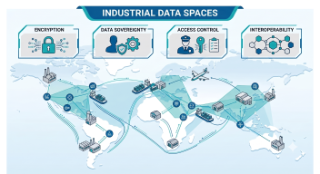
  • Easily utilize industrial data spaces: The Data Space Consumer from Fraunhofer IOSB automates secure, sovereign data exchange—covering everything from searching for data sources, identity verification, and contract negotiation to the actual transfer. This modular, open-source solution lowers technical barriers to entry and integrates flexibly into existing system landscapes.

    more info
  • LLM4OPC enables interaction with industrial systems via a secure, natural language interface. Through OPC UA and Asset Administration Shells (AAS), connected via the Model Context Protocol (MCP), Large Language Models (LLMs) can read live machine data, explain machine statuses in an understandable way, and - upon approval - execute actions.

    more info
  • QUILT - Quantum ghost imaging lighthouse project

    Remote sensing by means of entangled photons

    Novel applications of quantum technology for imaging - this is what the lead project QUILT is all about. At Fraunhofer IOSB, a technology for remote sensing using entangled photons is being developed.

    more info
  • WEALyR - Distant vibration measurement of wind turbines in operation

    Non-contact vibration measurement of wind turbine blades

    Ein Laservibrometer auf einem Schwenk-Neigekopf richtet seinen Messstrahl auf eine Windkraftanlage
    © Fraunhofer IOSB, indigo

    A laser vibrometry sensor on a pan-tilt head enables distant vibration measurement on wind turbine rotors.

    Significant costs in the operation of wind turbines (WTG) are incurred through maintenance and repair. Downtimes caused by such work must be minimized, but failures due to damage not recognized in time must also be avoided.

    more info
  • Active Sensors

    Active laser sensorics for reconnaissance

    Military reconnaissance in adverse atmospheric conditions requires imaging techniques capable of providing high-resolution images through scattering and turbulent media. Active imaging is the method of choice for critical applications where high precision and reliability are required.

    more info
  • Measuring wings in flight

    Innovative photogrammetry process

    Making aircraft more fuel-efficient is one of the aviation industry's most important goals. To this end, Lufthansa Technik uses AeroSHARK, a technology inspired by shark skin, which significantly reduces frictional drag and thus emissions. To attach the coating optimally, however, it is necessary to conduct flow simulations, which take the actual wing shape during flight into account. Measuring this is a challenge - and a specialty of the Fraunhofer Institute of Optronics, System Technologies and Image Exploitation IOSB. This was demonstrated during successful measurement flights by Lufthansa Technik.

    more info
  • SWAP – heterogeneous, workload-optimised robot teams and production architectures

    Hierarchical swarms working together (semi-)autonomously: As part of the SWAP lighthouse project, ten Fraunhofer Institutes are developing new technological concepts for the modular and self-organized production of the future.

    In the Fraunhofer SWAP lighthouse project, ten Fraunhofer institutes are developing technological concepts for the modular and self-organised production of the future, which will no longer be controlled centrally but decentrally - all the way to hierarchical swarms whose participants work together collaboratively and (partially) autonomously.

    more info
  • Factory-X – a sovereign data room for mechanical and industrial engineering

    An open data ecosystem for factory equipment suppliers and their customers - on the foundations of Industrie 4.0 and Gaia-X/Catena-X

    In the lighthouse project Factory-X, an open and collaborative data ecosystem for factory outfitters and operators is being developed on the basis of Catena-X and concepts of the Industry 4.0 platform. Fraunhofer IOSB is involved in or leading a number of use cases.

    more info
  • Secure Plug and Work

    A collaborative project within the framework of the BMBF announcement “Intelligent networking in production – A contribution to the future project Industry 4.0”

    Faster set-up and changeover: In the project, consistent plug-and-work capability was achieved in production-related software components - using the AutomationML and OPC UA standards. In the process, non-I4.0-communication-capable components are also retrofitted with I4.0 features.

    more info
  • "TRM4" (originally from: Thermal Range Model) is a software package developed over decades for the development and performance evaluation of optronic camera systems.

    more info