 Fraunhofer Institute of Optronics, System Technologies and Image Exploitation IOSB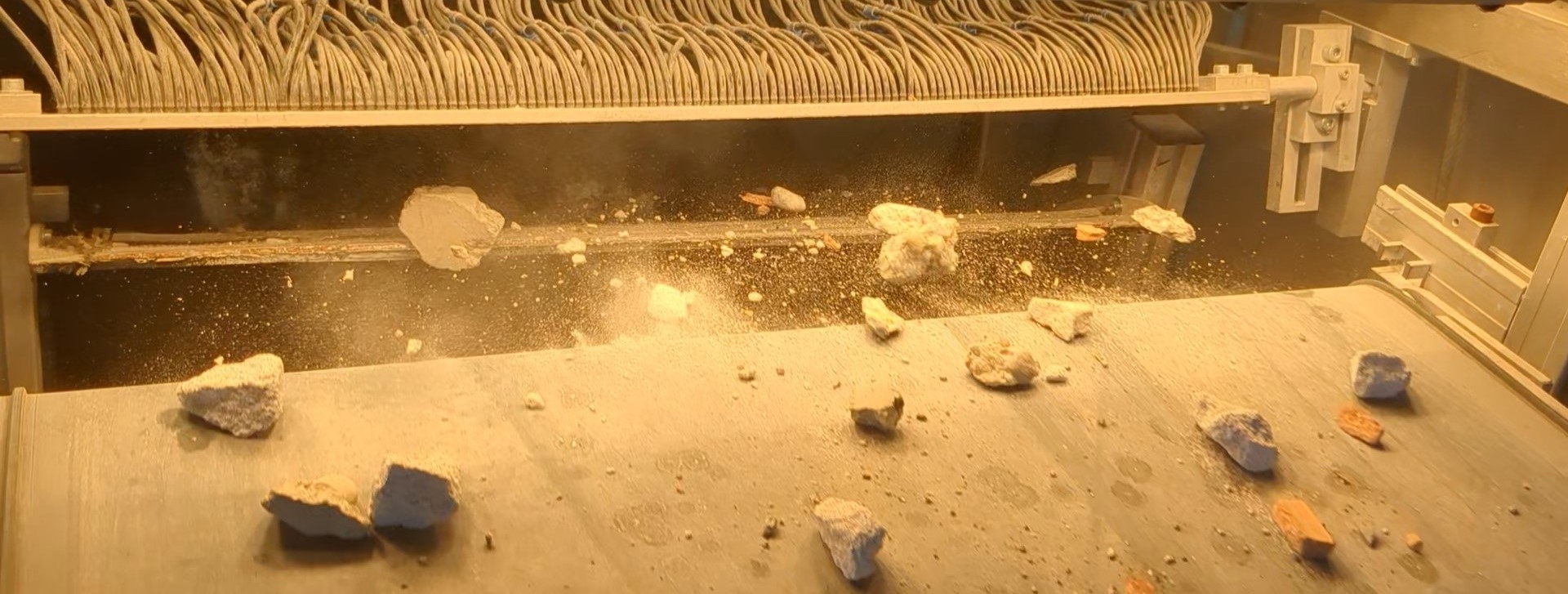
Brief description of the project
In our innovative research to optical sorting, advanced technology meets practical application. Our research focuses on the optimization of sorting systems through the use of Artificial Intelligence (AI), in particular Convolutional Neural Networks (CNNs) and Transformer, which outperform conventional image processing algorithms. CNNs show remarkable potential, especially for materials with complex visual properties and high occupancy densities. They close the gap for materials that can be distinguished with the trained eye, but do not allow simple differentiation based on color or shape. They work much faster and in some cases even more accurately than a manual sorter.
Project goals
Traditionally, sensor-based sorting techniques have been based on color and shape analysis or simple statistical models. AI methods are revolutionizing this field and offer significant improvements in object classification and recognition. Studies on AI-based image analysis have been demonstrating the potential for sensor-based sorting for several years now, but practical implementation has been lacking. Our Research & Development is breaking new ground by integrating the latest AI methods into practical sorting systems. The AI locates and classifies objects in the camera images. Shortly after the camera’s line of sight, pneumatic valves are precisely activated to remove unwanted objects from the material stream. Thanks to efficient implementation and high-performance graphics cards, the sorting system is designed for real-time operation—without any cloud computing. Even at high material throughput and belt speeds exceeding 3 m/s, a response time of less than 30 ms is achieved.
Fields of application and evaluation
The effectiveness of our approach has already been demonstrated in two challenging sorting tasks: the sorting of minerals with a high dust content and the detection of foreign bodies in food. These applications show the versatility and robustness of our AI-based sorting system. The technology can be used not only for applications such as food quality assurance, but also for material processing in waste recycling or mineral refining. We invite you to explore our comprehensive study that evaluates the real-time capabilities of the latest AI methods in sensor-based sorting, integrates advanced deep learning models and assesses sorting quality in practical applications. Discover how our work bridges the gap between theoretical research and practical implementation and sets a new standard in optical sorting technology. Read our publication, the download can be found at the bottom left of the web page.


